mini-gpt: a Hinglish GPT built from scratch, against a LoRA-tuned open LLM
A 5.3M-parameter GPT written from scratch in PyTorch and pre-trained on 98M tokens of Hinglish tweets, compared with classic NLP baselines and with Qwen3.5-0.8B (zero-shot, few-shot and LoRA fine-tuned) on the same SemEval-2020 SentiMix sentiment test set: 3,000 tweets, macro F1.
Results
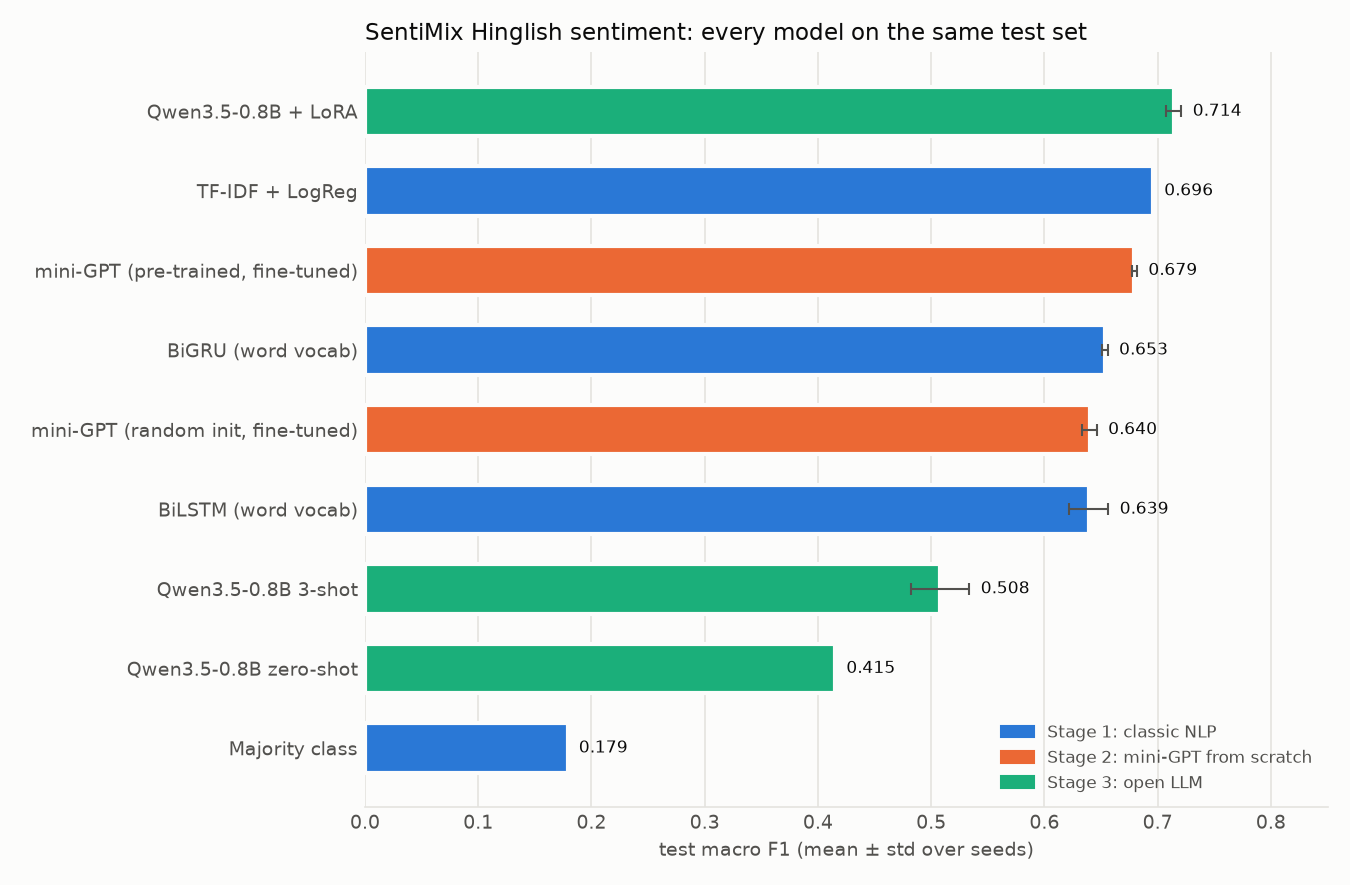
Every model on the same test set. Mean ± std over 3 training seeds (or 3 draws of the few-shot examples); the 95% interval is a paired bootstrap over the test tweets for one representative run.
| Model | Stage | Test macro F1 | 95% CI | Test accuracy |
|---|---|---|---|---|
| Qwen3.5-0.8B + LoRA | 3 | 0.714 ± 0.007 | [0.699, 0.730] | 0.710 |
| TF-IDF + LogReg | 1 | 0.696 | [0.680, 0.712] | 0.691 |
| mini-GPT (pre-trained, fine-tuned) | 2 | 0.679 ± 0.002 | [0.663, 0.696] | 0.676 |
| BiGRU (word vocab) | 1 | 0.653 ± 0.002 | 0.651 | |
| mini-GPT (random init, fine-tuned) | 2 | 0.640 ± 0.006 | 0.636 | |
| BiLSTM (word vocab) | 1 | 0.639 ± 0.017 | 0.638 | |
| Qwen3.5-0.8B 3-shot | 3 | 0.508 ± 0.026 | [0.490, 0.522] | 0.565 |
| Qwen3.5-0.8B zero-shot | 3 | 0.415 | 0.511 | |
| Majority class | 1 | 0.179 | 0.367 |
LoRA vs TF-IDF: +0.018 macro F1, 95% CI [+0.002, +0.035], a real but small win. TF-IDF vs the mini-GPT is not significant at 95%. Few-shot Qwen (0.508) almost never answers "neutral"; LoRA fixes that.
Explore the predictions
Pick a tweet to see each model's probabilities. The first six were written for this page; the rest are SentiMix test tweets where the models disagree (tweets with strong profanity skipped). Predictions were computed with the exact demo models and stored in this page; nothing runs live.
The mini-GPT
- Tokenizer: byte-level BPE (8,192 tokens) written from scratch and trained on the corpus: 3.74 bytes/token, no unknown tokens.
- Model: decoder-only transformer, 4 pre-norm blocks, d=256, 4 heads, context 128, weight-tied LM head.
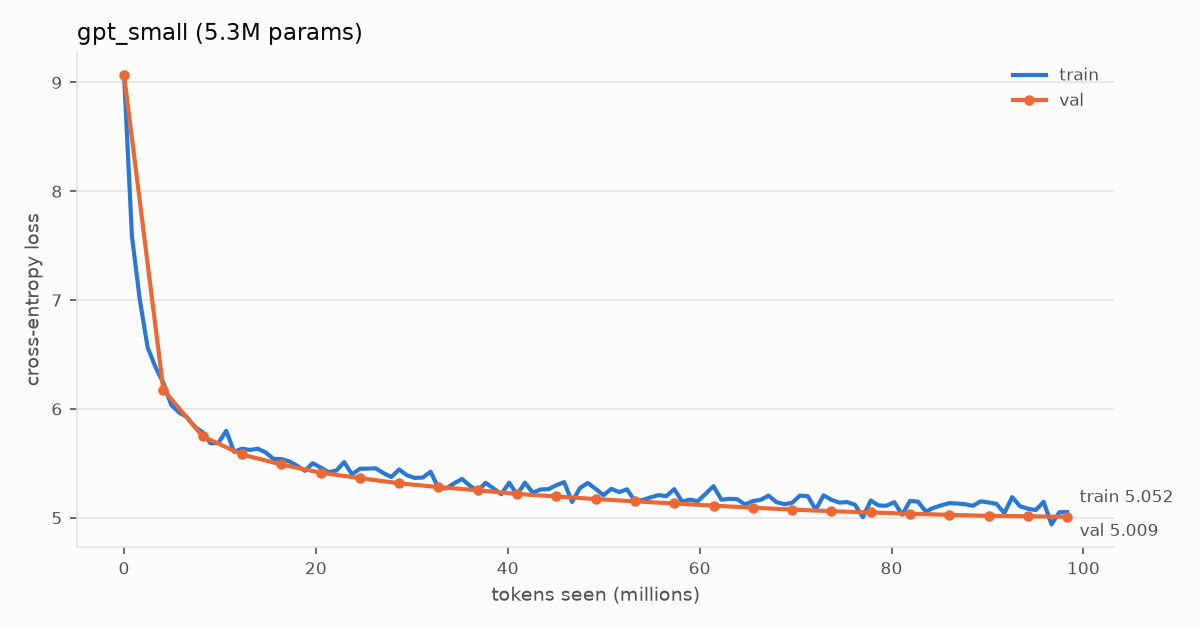
- Pre-training: 98M tokens of L3Cube-HingCorpus tweets, 12k steps, AdamW + warmup/cosine, 40 min on a GTX 1650 (fp32: fp16 was measured 4.6× slower on this GPU). Validation perplexity 8,659 → 150.
- Fine-tuning: classification head on the closing token; lr 3e-5, 3 epochs, 3 seeds.
Sample generations (temperature 0.7, top-k 50)
| Prompt | mini-GPT continuations |
|---|
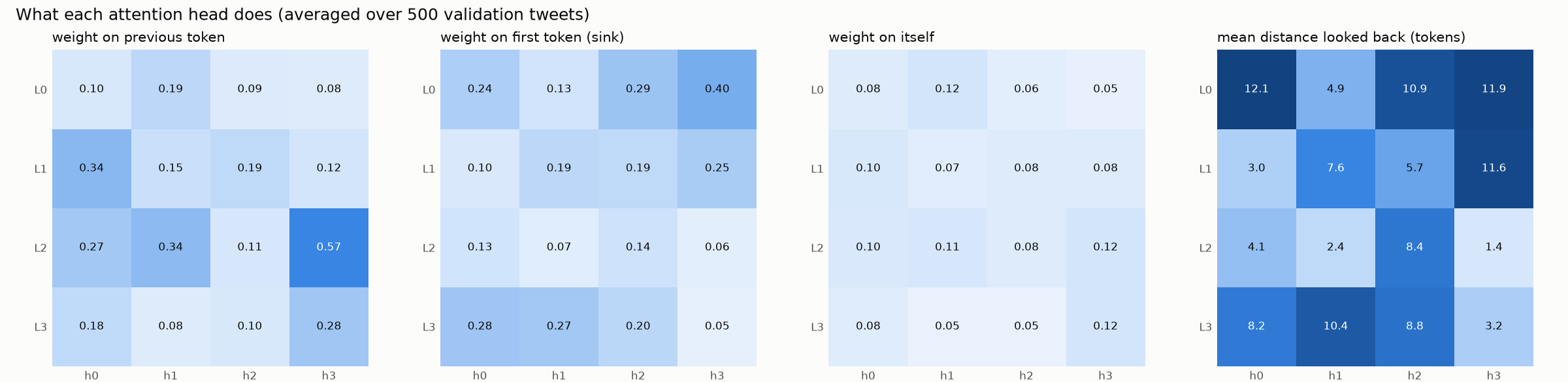
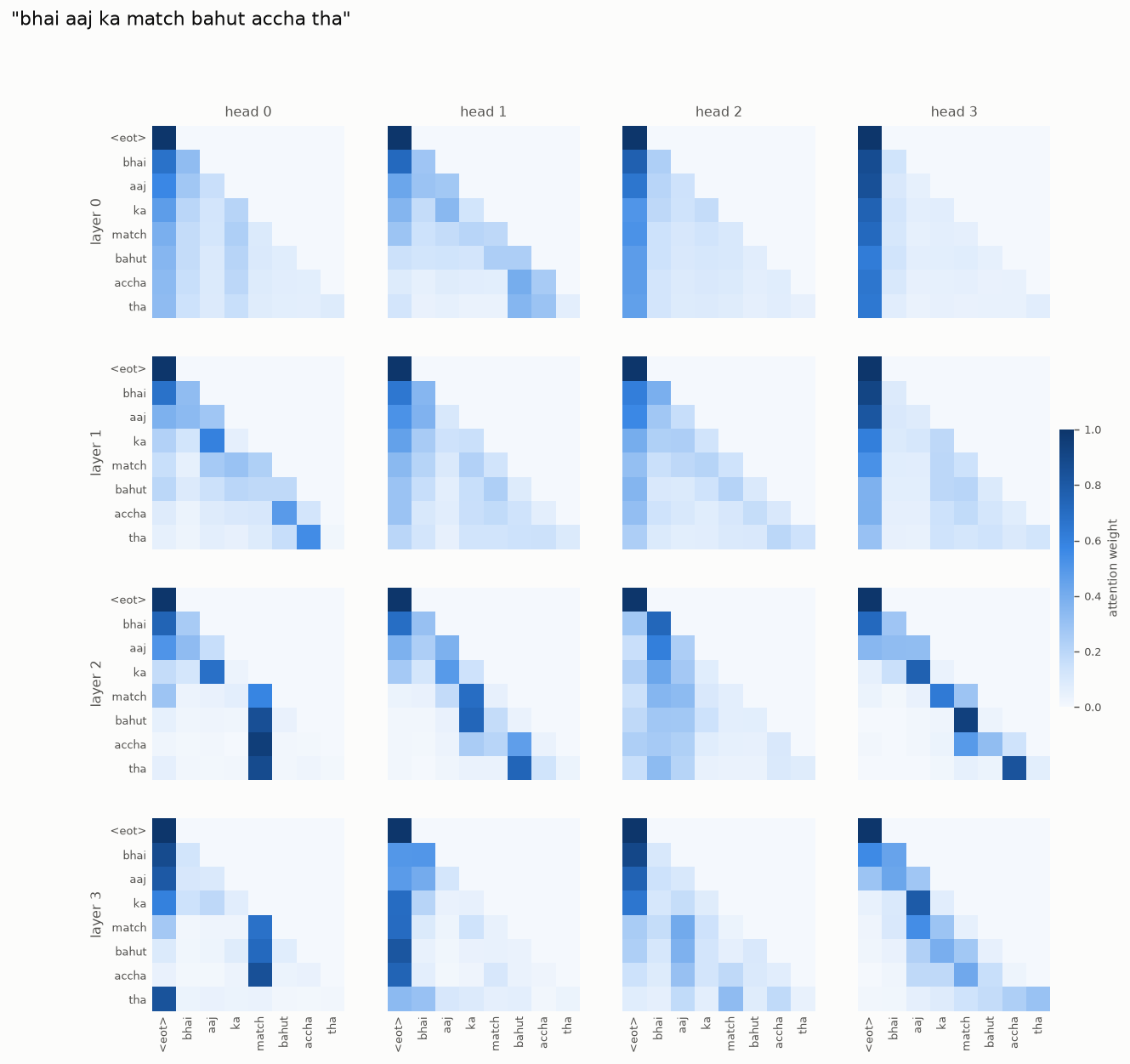
What the attention heads learned
What didn't work, and what it taught
- A word-level BiLSTM overfit within 3 epochs and lost to TF-IDF: 10.5% of validation words were unknown to its vocabulary.
- Fine-tuning the mini-GPT for 8 epochs overfit after epoch 1; short runs with the learning rate decaying over the whole run added ~1 F1.
- Contextual calibration made few-shot Qwen worse: its content-free inputs ("N/A") are genuinely neutral, so dividing out that "bias" removed the neutral class.
- fp16 mixed precision was 4.6× slower than fp32 on a GPU without tensor cores. Measure before assuming.
- Three times the best hyperparameter sat at the edge of the search range; extending the range changed or confirmed the result each time.
Run it yourself
The full live demo (classify with all three models, generate text, attention maps) runs locally from the GitHub repo:
pip install -r requirements.txt && pip install -e .
python -m minigpt.export_app
python app/app.py